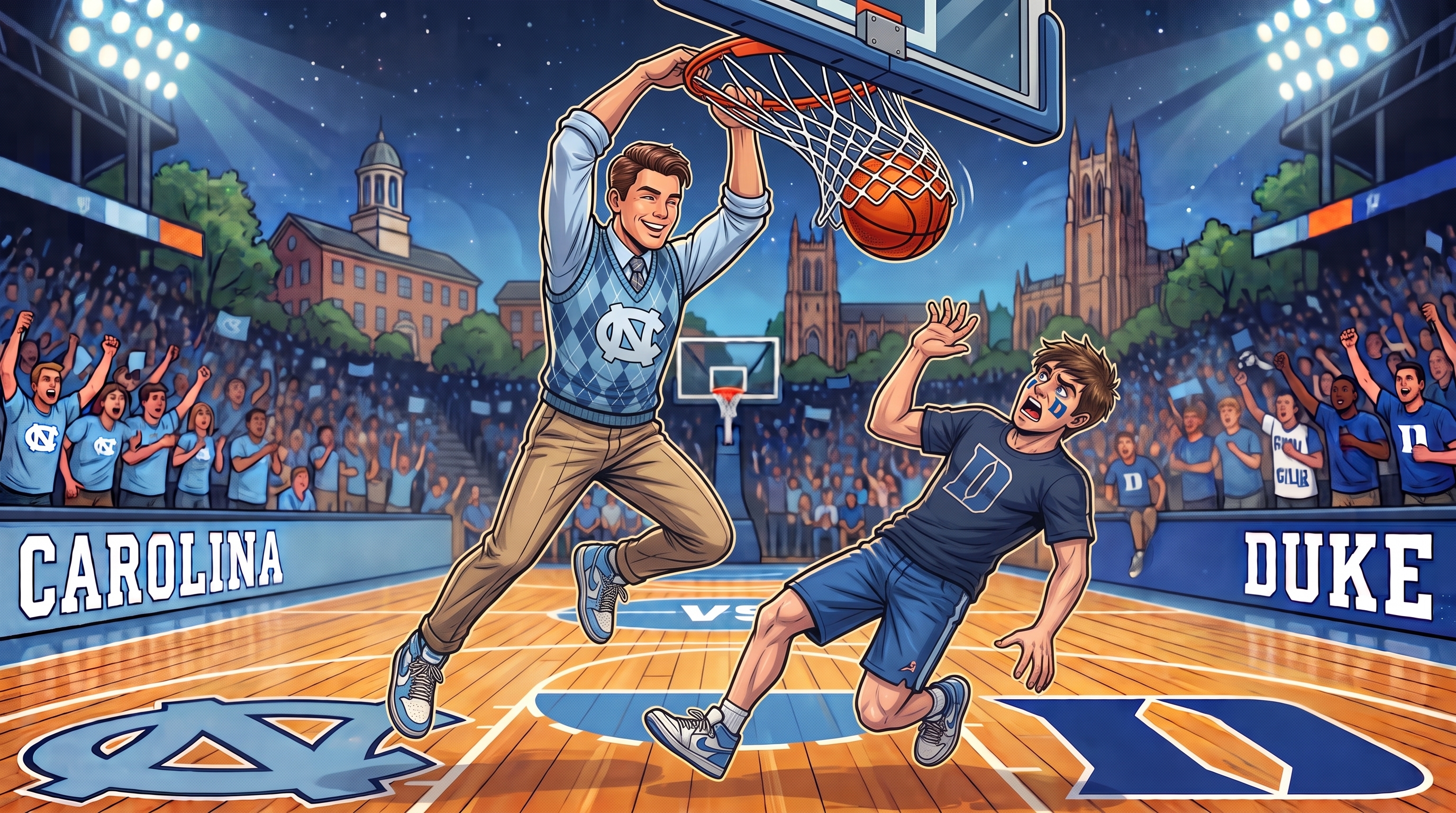
Two storied programs just eight miles apart -- and the AI gap between them is even closer.
|
P1 Commitment Named leadership, governance, strategy, and capital investment in AI. |
P2 Curriculum Campus AI tools, training programs, credentials, non-STEM courses, and compute access. |
P3 Partnerships Named industry partners, federal grants, and student career pipeline. |
P4 Research AI research centers, publication record, compute infrastructure, and fellowship programs. |
FINAL | |
|---|---|---|---|---|---|
Duke University Blue Devils |
2.8 | 3.9 | 1.1 | 1.2 | 9.0 |
UNC-Chapel Hill Tar Heels |
3.0 | 3.9 | 1.1 | 1.2 | 9.2 |
Two storied programs just eight miles apart -- and the tightest AI battle we've run to date.
Maybe there's something in the water down in the Raleigh-Durham Triangle, because we haven't seen AIREDEX™ scores this high from two neighboring schools since we started rating AI readiness back in April.
When we rated Duke a few weeks ago, the Blue Devils' 9.0 put it 13th in the country -- an impressive showing to be sure. But then the Tar Heels showed up, and proceeded to one-up (actually two-up) the Dukies with an impressive 9.2 -- knocking Duke down to 14th and locking in #9 nationally.
How did we get here?
Duke's case rests on where it's headed: engineering faculty have proposed a dedicated AI Engineering major targeting a fall 2027 launch, backed by lead status on the $20M NSF Athena Institute and a $30 million campus computing investment through Elevating Duke Computing.
Carolina's case rests on what's already in students' hands: PromptLab, a free university-built AI platform spanning OpenAI, Anthropic, and Google, a new undergraduate AI minor, and free GPU compute through Longleaf.
And to be fair, the programs are very close in terms of AI readiness, with dead-even scores in Curriculum (3.9 to 3.9), Partnerships (1.1 to 1.1), and Research (1.2 to 1.2) -- both schools carry the Leading Edge designation.
However, UNC outpaces Duke in campus-wide AI governance and leadership; UNC's Saif Khairat holds a university-wide CAIO / Vice Provost for AI title, while Duke's strongest AI leadership role is scoped to the School of Medicine only and doesn't clear the university-wide bar. It is a small, but important distinction when it comes to commitment to AI readiness.
That said, the two standout institutions are both very impressive in their commitment to preparing undergraduates for an AI-driven world -- proof that whatever's in that water, it's working.
UNC took the first quarter on the strength of a single title. Duke's strongest AI leadership role, a Vice Dean for Data Science and AI, sits at the School of Medicine level only and doesn't clear the undergraduate-relevance bar. UNC's Saif Khairat holds the CAIO / Vice Provost for AI title -- university-wide in scope, even though UNC's own announcement frames it as a secondary appointment. Duke counters with the bigger checkbook: lead status on the $20M NSF Athena Institute plus $30M for Elevating Duke Computing. The title outweighs the dollar gap this quarter.
First quarter: UNC 3.0, Duke 2.8
Dead even in the second quarter. Duke built its own AI platform, DukeGPT, and backs it with two undergraduate AI minors and coursework across five-plus non-STEM departments. UNC counters with PromptLab, a free multi-model platform spanning OpenAI, Anthropic, and Google, a new AI minor of its own, and free GPU compute through Longleaf. Neither school gives an inch.
Second quarter: Duke 3.9, UNC 3.9 (tie)
Another tie in the third. Duke's Microsoft partnership includes a named Duke Health AI Innovation Lab and Center of Excellence, plus lead status on two federal AI grants. UNC is lead institution on the $10M ARPA-H CIPOC cancer-AI grant and has its own named industry partner in Rethinc. AI Management Lab's relationship with Advance Auto Parts, though at meaningfully smaller scale than Duke's Microsoft precedent.
Third quarter: Duke 1.1, UNC 1.1 (tie)
Tied again in the fourth. Duke's research engine spans the Interpretable ML Lab, led by 2025 IJCAI McCarthy Award winner Cynthia Rudin, and AI Health publication activity across six departments. UNC's SAIL and CAIPH institutes continue to expand, backed by the ARPA-H cancer-AI grant. Both schools max out this pillar.
Fourth quarter: Duke 1.2, UNC 1.2 (tie)
UNC wins the Tobacco Road Showdown 9.2 to 9.0. The gap is entirely in Commitment -- a named, university-wide AI title UNC has and Duke doesn't. Curriculum, Partnerships, and Research all end in a dead heat. Both schools carry the Leading Edge designation, and both are building the kind of undergraduate AI infrastructure that will outlast this year's scores.
Final score: UNC 9.2, Duke 9.0
Database access across all scored institutions, pillar breakdowns, source citations, and other tools built for the professionals advising students and institutions.
AIREDEX™ is the first independent AI Readiness Index for American universities. We welcome press inquiries, interview requests, and data licensing conversations from journalists and media organizations covering higher education and artificial intelligence.
Subscribe to receive AIREDEX™ updates, new school scores, annual AI Readiness Reports, and insights on how universities are responding to the AI revolution.