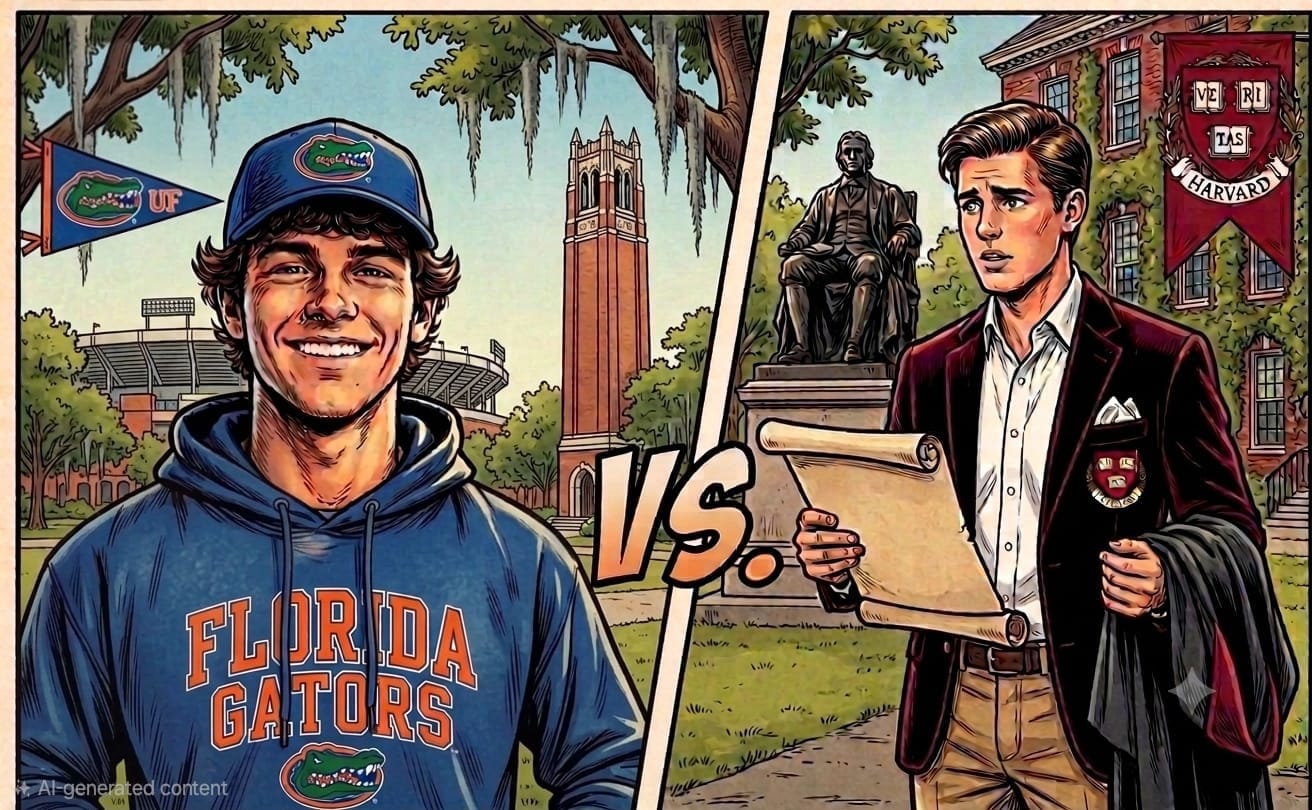
One school is five times harder to get into. The other has more undergraduate AI infrastructure.
|
P1 Commitment Named leadership, governance, strategy, and capital investment in AI. |
P2 Curriculum Campus AI tools, training programs, credentials, non-STEM courses, and compute access. |
P3 Partnerships Named industry partners, federal grants, and student career pipeline. |
P4 Research AI research centers, publication record, compute infrastructure, and fellowship programs. |
FINAL | |
|---|---|---|---|---|---|
University of Florida Gators |
3.3 | 3.9 | 1.3 | 1.2 | 9.7 |
Harvard University Crimson |
2.6 | 3.4 | 1.0 | 1.2 | 8.2 |
Harvard is Harvard University. But University of Florida got it beat on weather, sports, and...... AI.
For the past few months we've been posting a lot about AI, specifically how colleges and universities are preparing their students for an AI-driven economy.
So when someone asked us to use our Airedex.ai engine to score Harvard, we assumed the Crimson would rise straight to the top of the AI readiness pile.
Little did we know the Gators down in Gainesville would beat Harvard so soundly.
Our Airedex engine pulls hundreds of data points across institutional commitment, curriculum integration, industry partnerships, and research output, then every score gets reviewed by an actual human before it's published.
The final tally?
Harvard: 8.2 out of 10.
University of Florida: 9.7.
Before anyone in the comments brings out the receipts: yes, Harvard's AI research is elite. A $500 million AI institute, a 1,144 GPU cluster, an in-house AI Sandbox built by 40+ engineers. None of that is in question.
Buuut, Harvard doesn't have a single undergraduate AI major, minor, or certificate. Not one. Every AI credential at Harvard is graduate level or continuing education, the stuff that doesn't count if you're an undergrad actually trying to learn this.
UF has a certificate open to literally any major on campus. AI coursework confirmed across all 16 colleges. An NVIDIA partnership with an actual on-campus facility and dedicated staff, not just a research collaboration. The fastest university owned supercomputer in the country, free for students to use.
Of course Harvard is 5 times harder to get into than Florida, and that's not likely to change.
But when it comes to preparing its students for the AI revolution, that math may change in the Gators' favor.
UF edged ahead in the first quarter, and this pillar carries the widest gap of the matchup. Harvard's University Generative AI Steering Committee, Provost's Office guidelines, and the $500M Kempner Institute gift are real institutional commitment signals, but two structural pieces pull the pillar down: Harvard has no named university-wide AI executive, and no standalone undergraduate AI major or concentration. UF's AI² Center has a provost-level director with an explicit AI mandate.
First quarter: UF 3.3, Harvard 2.6
The second quarter is where the gap widens, and it is the heart of this matchup. Harvard's AI Sandbox is a genuinely impressive university-built platform with access to GPT-4o, Claude, Gemini, and more. But UF's NaviGator AI does the same thing with 40+ models and full deployment across all 16 colleges, while Harvard's curriculum integration -- strong as it is in Law, Medicine, Business, and Public Policy -- has no undergraduate AI minor or cross-disciplinary certificate at Harvard College. UF's AI Fundamentals and Applications Certificate is open to any undergraduate regardless of major. That single structural gap is the difference between the two schools.
Second quarter: UF 3.9, Harvard 3.4
The third quarter was Harvard's toughest. Its named partnerships with Microsoft, the Allen Institute for AI, and NVIDIA are real, but none come with an on-campus facility or dedicated staff -- the OLMo collaboration is a research deliverable, not infrastructure. UF's NVIDIA partnership is a different category entirely: a named $70M on-campus facility, dedicated staff, and joint products already in clinical use, on top of leading two flagship federal AI programs.
Third quarter: UF 1.3, Harvard 1.0
The fourth quarter is a near tie, and the only pillar where Harvard fully holds its own. The Kempner Institute -- co-directed by Sham Kakade and Bernardo Sabatini, with a 1,144 GPU cluster and active 2026 fellowship cohorts -- is a flagship-caliber research engine. UF's AIIRI, with roughly 100 affiliated faculty and 140+ papers, performs at the same level. Both schools maxed this pillar.
Fourth quarter: UF 1.2, Harvard 1.2
Final score: UF 9.7, Harvard 8.2
University of Florida wins the AIREDEX™ Ivy v Swamp Showdown 9.7 to 8.2. Both schools carry the Leading Edge A(I)ttitude™ designation, and for good reason -- this isn't a story about one school taking AI seriously and the other not. It's a story about where that seriousness shows up. Harvard's investment lives overwhelmingly in research and graduate education. UF built the same caliber of infrastructure and pointed a meaningful share of it directly at undergraduates. The brand gap between these two schools may not be closing anytime soon. Time will tell if the AI readiness gap between the two schools does.
Database access across all scored institutions, pillar breakdowns, source citations, and other tools built for the professionals advising students and institutions.
AIREDEX™ is the first independent AI Readiness Index for American universities. We welcome press inquiries, interview requests, and data licensing conversations from journalists and media organizations covering higher education and artificial intelligence.
Subscribe to receive AIREDEX™ updates, new school scores, annual AI Readiness Reports, and insights on how universities are responding to the AI revolution.