Introduction
AIREDEX™ is an independent research company founded in early 2026 with a sole purpose: identify what colleges and universities are doing to help prepare their students for a future that is increasingly impacted by AI.
Our primary goal is to provide a trusted source of insight for the millions of potential college applicants and their families to determine if the schools they are looking at are going to best position them for a career after the four years they will invest in their degree.
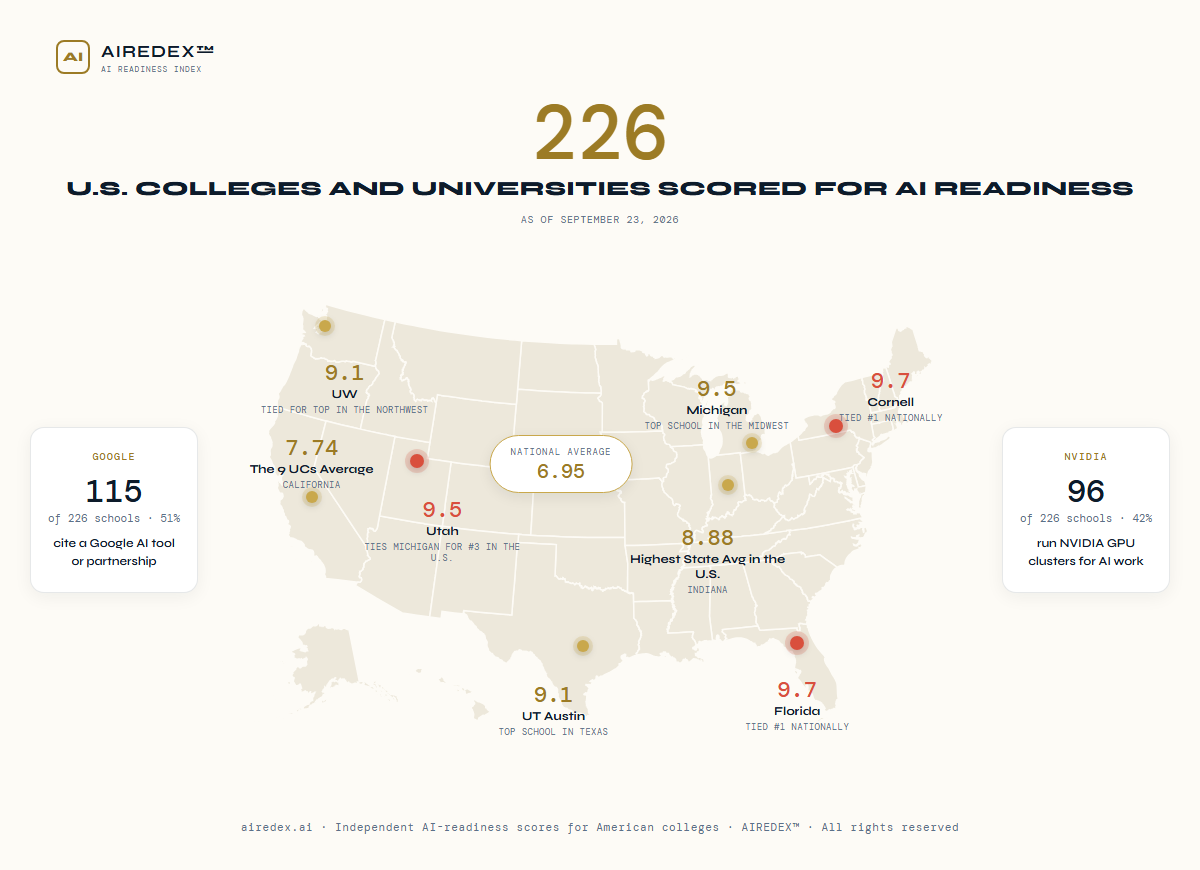
Our first ranking of national AI readiness in higher education features 226 schools, with the majority, 177, defined as R1 national research institutions.
No school has paid for any review or score; this report is entirely independent, and is based on thousands of hours of research and editorial review.
What is AI readiness? And why should we care?
This question is best answered in reverse.
Do we care about AI readiness because Dario Amodei (Anthropic's CEO) went viral when he said that half of all entry level jobs (typically taken by recent college grads) would be replaced by AI within 5 years? Yes.
Do we care because NACE (the National Association of Colleges and Employers) just reported that job listings requiring AI fluency tripled over the past year? Definitely.
But most importantly, we care because AI is impacting all parts of society, and students, whether in high school or new to college, will be impacted the most, and for the longest period of time, by AI.
But what, exactly, is AI readiness, and what, if anything, are our institutions of higher learning doing to react to AI disruption?
When we started to research this question 10 months ago, we dove headfirst into what the best colleges were doing: were they creating AI classes? Developing AI policies? Conducting research into AI to benefit their students? Did they launch an AI minor or certificate? An AI major? And would AI education be available outside CS and engineering?
The more we dug, the more questions we had, and the more discoveries we made. Ultimately, we used what we learned from the top 50-100 schools to shape the framework, and we went to work building the engine to identify and categorize primary AI readiness factors. With that in hand, we created a rubric to weight factors, score categories, and to rank every R1 school in the US (plus a few dozen others).
We now publish an AI report card for every school we scored (this being academia), with four main areas of performance reporting: Governance & Leadership, Curriculum & Coursework, Industry & Capital Partnerships, and Research Depth & Funding.
Why these categories? After thousands of research runs and iterations, these were the areas that we determined would have the most impact on a school's ability to prepare its students not just for AI literacy, but true fluency: the ability to leverage AI tools and capabilities across disciplines and subject matter, regardless of major, to make students more capable, powerful, and employable.
The Playing Field
We realized early on that large national research universities (R1 by Carnegie classification) would likely outperform smaller schools, especially the smaller, liberal-arts-focused ones. It stands to reason: a school with 10-20k undergrads, a state budget, and a research endowment simply has more capability, reach, and resources to build out AI infrastructure than a 2,000-student liberal arts college does.
Obviously the model biases toward larger, well-resourced schools. However, even among the largest schools (both public and private), there is divergence, as no two institutions approach AI the same way. This is why our rubric is granular, and is meant to identify each school's particular strengths, capabilities, and general attitude toward AI readiness (that's where our A(i)ttitude comes from).
A(i)ttitude captures more than whether a school has adopted AI tools — it measures how a school approaches AI: as something to lean into, or something to cautiously manage. Two institutions with nearly identical budgets and research output can land in very different places on our rubric depending on that institutional posture. In short, A(i)ttitude scores a school's disposition toward AI, not just its output.
The large publics
Public flagship universities dominate the top of the national AI readiness list, and by a wide margin — six of the ten highest-scoring public universities land in our overall top 16, powered by state-funded compute, federal research grants, and system-wide AI initiatives that a single private campus rarely matches alone.
What's interesting is that the ranking of these schools does not necessarily align with well-known national "prestige" rankings. Leader University of Florida ranks 34th on the latest US News report on top publics, with our second place Michigan at 26th. Perhaps the biggest disconnect is with the University of Utah — which is tied for third in the country in AI readiness, but comes in 179th on the US News list!
None of these ten schools crack the U.S. News top 25 nationally — Michigan and UNC Chapel Hill come closest, at #26 and #27. It's a sign that traditional prestige rankings, built on selectivity, endowment, and reputation surveys, haven't caught up to AI readiness as something worth measuring. Yet.
| School | Rank (Overall) | Score |
|---|---|---|
| University of Florida | 1 | 9.7/10 |
| University of Michigan | 3(t) | 9.5/10 |
| University of Utah | 3(t) | 9.5/10 |
| Penn State University | 5(t) | 9.4/10 |
| Purdue University | 5(t) | 9.4/10 |
| UNC Chapel Hill | 11(t) | 9.2/10 |
| University of South Carolina | 11(t) | 9.2/10 |
| University of Tennessee, Knoxville | 11(t) | 9.2/10 |
| University of Wisconsin-Madison | 11(t) | 9.2/10 |
| Oregon State University | 16 | 9.1/10 |
The large privates
Private research universities compete at the very top too nationally, but with a slightly different playbook — endowment dollars and single-campus decision-making standing in for state budgets and system-wide mandates.
Prestige and AI readiness don't move in lockstep among the privates either. Northeastern ties for #9 in our AI rankings despite sitting at #42 in U.S. News' national list — the widest gap of any private school in our top group. USC tells a similar story: tied for #9 here, but #27 nationally. Even Cornell and Columbia, both inside the U.S. News top 15, aren't at the very top of that list the way they are on ours. Being AI-ready and being an elite, highly selective institution turn out to be related but not interchangeable.
| School | Rank (Overall) | Score |
|---|---|---|
| Cornell University | 1 | 9.7/10 |
| Columbia University | 5(t) | 9.4/10 |
| Vanderbilt University | 5(t) | 9.4/10 |
| Northeastern University | 9(t) | 9.3/10 |
| University of Southern California | 9(t) | 9.3/10 |
| University of Pennsylvania | 11 | 9.2/10 |
| University of Notre Dame | 16 | 9.1/10 |
| Case Western Reserve University | 21(t) | 9.0/10 |
| Duke University | 21(t) | 9.0/10 |
| Stanford University | 21(t) | 9.0/10 |
The smaller schools: top performers and laggards
Smaller schools split hard into two camps. A handful of under-the-radar names outscore some of the most selective colleges in the country — and five of America's most prestigious liberal arts colleges cluster at the very bottom of the entire national ranking, publics and privates included.
Colby is the surprising star here, especially given its size — under 2,200 undergrads — and its reputation as a traditional liberal arts college in rural Maine, not the kind of place you'd expect to out-AI schools ten times its size. West Point landing near the top of this list is surprising too, though probably reassuring: the institution training America's next generation of military officers is taking AI seriously.
| # | School | Rank (Overall) | Score |
|---|---|---|---|
| 1 | Colby College | 44 | 8.4/10 |
| 2 | United States Military Academy | 56 | 8.2/10 |
| 3(t) | Bentley University | 71(t) | 7.9/10 |
| 3(t) | Fairfield University | 71(t) | 7.9/10 |
| 5 | University of Richmond | 76 | 7.8/10 |
| 6 | Bowdoin College | 89 | 7.5/10 |
The schools that bring up the bottom of our rankings are, by most other measures, still exceptional — incredibly selective, elite institutions. Their focus simply isn't on AI readiness, at least not yet. Students at these schools will no doubt receive extraordinary educations, even if they graduate with a smaller AI skillset than peers from higher-ranked schools.
| # | School | Rank (Overall) | Score |
|---|---|---|---|
| 1 | Pomona College | 226 | 2.8/10 |
| 2 | Swarthmore College | 223 | 3.4/10 |
| 3 | Washington and Lee University | 222 | 3.5/10 |
| 4 | Claremont McKenna College | 220 | 3.6/10 |
| 5 | United States Naval Academy | 215 | 4.2/10 |
| 6(t) | Bucknell University | 203(t) | 4.9/10 |
| 6(t) | Wellesley College | 203(t) | 4.9/10 |